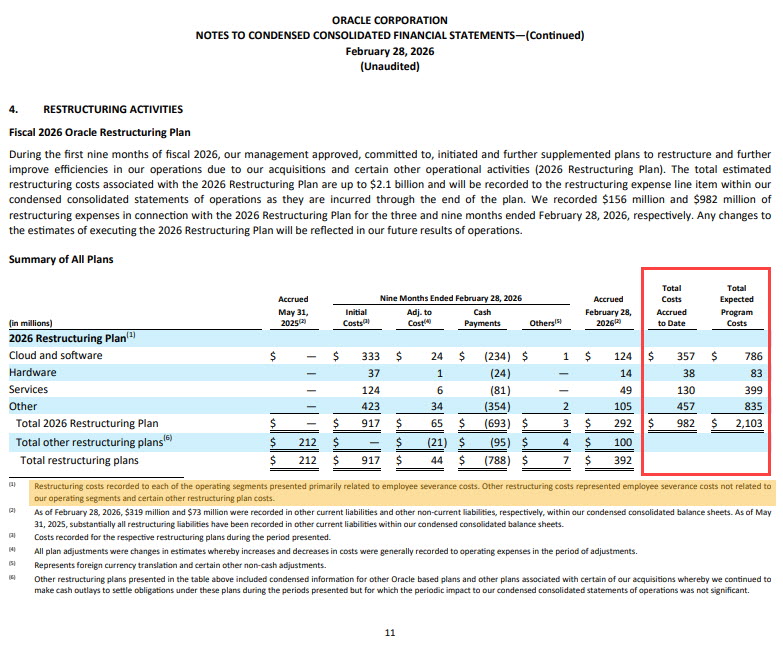
Less $982b total costs accrued to date (June 2025 through February 2026)
Which leaves $1,121b to be accounted for
1 Restructuring costs recorded to each of the operating segments presented primarily related to employee severance costs. Other restructuring costs represented employee severance costs not related to our operating segments and certain other restructuring plan costs.
Or, all the ways that employee recognition could return to Oracle. Oracle must change to see employees as essential resources that build the company, who can be invested in, upskilled and retained to grow employee productivity, contribution and satisfaction.
Intro
A business can think of its “human capital”, or it can see people who help deliver its mission. The way that your company describes its workforce, and the approach that management takes in building opportunity, providing growth, and celebrating employees is reflected in the culture and success of its teams and for the company as a whole.
Notably, Oracle shows zero loyalty to employees. Trust is a reciprocal belief, and Oracle is not a trustworthy partner to its workforce. There is a profound lack of transparency, a history of suppressing open communication, and a failure to recognize and celebrate achievement. Ultimately, Oracle is a company that sees its employees as skilled labor assets only (drop assets here, purchase new assets in this lower cost-center or with these skillsets).
Hiring Practices
Employee development and retention starts by hiring with the intention of building a culture and identifying talent. Skills can be trained, but aptitude and fit as well as onboarding practices matter greatly to the overall success and retention of a new hire.
Hire for potential, hire for aptitude
Experience timely hiring practices by funding and committing to requisitions, and fulfilling those positions in timeframes that don’t exceed 30 days from the closure of the application period.
Ensure that onboarding programs take place for all new employees
Create mentorships or buddy programs for newhires
Make time to introduce newhires to their teams and partner organizations
Recognize the Person over the Employee
Practice Work/Life Balance
Encourage Time Off
Allocate discretionary budgets to managers so that teams can respond to life events for their peers (bereavement, retirement) and consider life awards (graduation, birth, moves, etc.)
Recognize Teams
Teams can be functional teams (all reporting to one manager), cross-functional teams, project teams, and even cross-business unit teams. A team can be three people, or forty people. Teams can be informal or formal. The ability to form, collaborate, and storm through to performing well should be recognized as a keystone of employee productivity.
Practice Curiosity, Practice Thanks
Recognize that a significant part of any person’s daily life is spent at work. Take time to get to know people on your team, and learning and respecting them as a whole person. Meetings can include a short period of open discussion that can include introductions, “catching up”, and recognition or work. Meetings can close with a question “What do you need?”
Build time for recognition. Take time to provide personal notes for fellow employees. A small note, or a quick email to recognize another employee is often appreciated, and more-so over time when consistently practiced within the team. If you have an employee recognition system that allows peers to submit recognition for an employee, that becomes a valuable tool to understand contributions, honor work, and build a practice of thanks.
Build Growth with Goals
Employees (all employees) should include growth and personal achievement goals in their annual objectives. These goals can be:
Training and certification (and an allocated budget for training and travel),
Departmental cross-training,
Unique leadership opportunities within the team or company,
Participating in an employee mentorship program,
Time granted to lead Employee Resource Group (ERG) activities,
Commitment to lead or participate in volunteer projects, or
Plans and a path to apply for a promotion in the upcoming year
Recognition and growth through speakerships, whitepapers, and research
Commitment to Accountability, Not Clocks
Good management will understand that accountability is more important than hours in the office. A good employee recognizes that timely delivery of work is crucial, but will appreciate flexibility of daily schedules.
Good Tools = More Productivity
Company practices should include inspection of their internal tools, with an eye towards process improvements around collaboration, discovery and production. This is often overlooked, but an incredibly important part of overall employee satisfaction.
Systems should be:
Intuitive,
Accessible,
Integrated,
Perform well, and
Have good systems of support
Commit to Focal Cycle and Bonuses
Organizations that fail to reward employees for positive quarters are failing to recognize its most important asset – its workforce.
Allocate sufficient funds and RSUs to the focal cycle, and for annual bonuses – if a quarterly profit is expected, there should be money on the table for employees. Prioritize employees over managers, and managers over executives.
Grant management enough time to properly conduct reviews, with consideration of the number of direct reports each manager is responsible for.
Measure Promotion, Celebrate Retention
A good company is recognized by employee loyalty. If your company is monitoring acceptable attrition rates, that’s a sign that they don’t care about the people. Instead look at rates of internal promotion, discover groups that regularly promote up; and monitor retention rates.
Attach meaningful awards to work anniversaries (i.e. time off, or contribution to a savings plan).
Determine tenures that can be granted eligibility for work hiatus or “special projects” as planned for.
Commit to Managing Organizational Change
One of the biggest failings of management is in how it plans and communicates organizational change.
Limit change to minimize disruption – reorganizing a business unit or changing priorities has a cascading effect for teams, projects and products. Minimize the churn by establishing good, long term missions, values, and objectives that can be reliably planned for. Leaders should represent the mission and culture of the organization, rather than leading by a cult of personality
Communicate early so that organizations can plan and organize for changes in roles and responsibilities, directories and permissions, projects and backlogs, content management, to manage support workloads, and especially for critical feedback.
Transparency matters – honest discussion about the reasons for change require that management has committed to a path, and can communicate why a change was required and what it will impact.
Retrain to retain – instead of losing valuable organizational knowledge, find ways to repurpose existing employees rather than fire and hire
Oracle is a historically conservative company, and its leadership are unabashedly conservative. The company has a history of funding and working closely with conservative lawmakers and policy wonks to shape both political favor and to curry interest in Oracle products.
Oracle values its proximity to the Trump administration and its social circles. Oracle was a key player in the Project 2025 database buildout of faithful Trump allies. Oracle worked closely with the Trump administration to become a key player in the Stargate AI initiative.
Moses told Fortune last week that companies with government contracts will begin to change how they make business decisions, including hiring, based on cuts. He added that as more fired federal workers seek out jobs, they may find fewer private-sector opportunities as a result of contract losses, contributing to an “unvirtuous cycle.” – fortune.com
What do you think will happen in the 2026 midterms if, as predicted, the House and Senate become Democrat majorities, and Trump’s levers of power are no longer in control of congress? And what will happen in 2028 when Trump is no longer in office? The end of Trump means the end of Larry and Safra’s curried special status with the executive branch. Their long game will have come to naught.
There is a huge risk that Oracle is taking to acquire data to train its AI, and to embed itself as a global cloud provider that will house the information of corporations, media and the government. Oracle’s goal is to control content, to access data, and predict the future. And it’s risking its own future to do so.
It’s September 2025, and Oracle is rolling out its annual “Your Voice” survey to the employees who remain, after several large rounds of reductions in workforce took place. There are still employees in garden leave (on notice but unable to access the network until their last day on September 22) while the invite goes out. Internally the mood of employees is somber because every round of layoffs take place unannounced, with no organizational change taking place. Remaining employees have to discover who was let go by peeking in places to see what accounts have been suspended, or look for email bounce-backs when communicating with each other, then share that information with their teams.
This isn’t about AI
This is about a commitment to company culture. It’s about recognizing and growing talent in your organization, and the ability to nurture a workspace where employees are welcome and others want to work. Oracle makes it clear that there is no company loyalty.
The Contradiction of Voices
The “Your Voice” survey is doublespeak at Oracle. There is no real interest in improving the workplace; its about how far the company can go to let employees be uncomfortable in their workspace. They measure the levels of acceptable attrition more than employee satisfaction.
Oracle is excited to launch the global Your Voice employee survey. Your participation and feedback are instrumental in shaping the future of how we work. By sharing your unique perspective, you are helping Oracle create a better employee and customer experience.
Survey Intro
The #1 issues in survey responses are equitable pay, and requests to attach performance reviews with compensation; and every year the company either turns a blind eye or have management explicitly shut conversations down.
This year there were early announcements from senior management that there would be no focal, no bonus, and only dry promotions.
No Anonymity in Completing the Survey
Survey responses are not anonymous, and that creates a tension for employees. They are unable to provide feedback without having their responses tied back to them. At the highest level, HR connects survey responses to your personal information. Managers receive aggregate feedback for seven or more respondents, and it’s relatively simple to drill down to the lowest functional manager in a group to review answers, and tie each response to an individual employee. If you include text comments, your writing style and topics of response are considered. Even if you use only ratings, it becomes a profile to match against your HCM record.
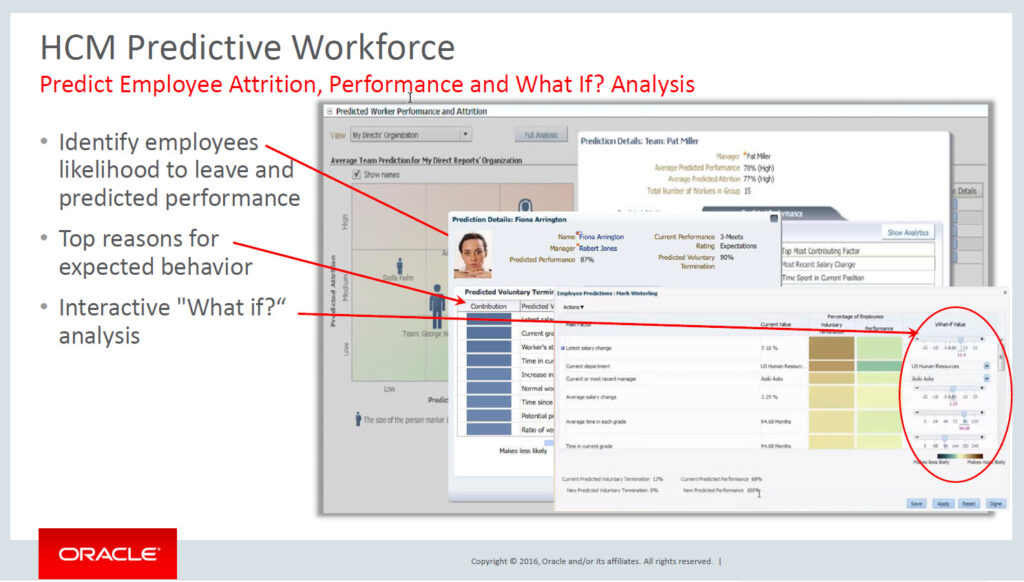
Oracle Open World 2018, Developing Predictive Applications with Oracle Machine Learning
Employees have to decide whether to speak truthfully about their workplace experience, knowing that the result can be detrimental to their career, or in elimination of their positions. Although “optional”, managers push employees to complete surveys to achieve artificially high response rates in their org. The metric for organizational engagement in survey response literally has more focus than organizational response to the survey issues.
The Employee Loyalty Index
Every Oracle employee has a “Loyalty Index” (LI). This has been a part of Machine Learning algorithms in Oracle Advanced Analytics for over a decade, and is part of the Human Capital Management Suite. It is contemplated that employees with low LIs are at the top of the layoff ranking lists. Source: https://www.thelayoff.com/t/1k2jkgj52
It’s not about performance, or value of contribution, or thought leadership. It’s about how well you can stay engaged while being overlooked and overworked.
Consider that good, productive employees who routinely provide honest feedback and are ignored will eventually turn a sour note. The company is willfully unresponsive, and will continue to do nothing unless a change is forced on them by its employees; and Oracle depends on the likelihood of that remaining low.
The huge hole in the logic of a loyalty index is that the company shows zero loyalty to employees. Trust is a reciprocal belief, and Oracle is not a trustworthy partner to its workforce. There is a profound lack of transparency, a history of suppressing open communication, a failure to recognize and celebrate achievement. It should be no surprise that even committed, productive employees are unable to achieve a high loyalty index.
A Lack of Meaningful Improvements for Employees
These are my responses from the 2021 employee survey, shortly after the first major RIF took place in August 2020. None of the issues raised here have been addressed, and it’s fair to say that it has only gotten worse.
Whether you work there now or not, consider the kind of culture that Oracle advertises, versus how it practices. It’s all Deflect, Deny, Defend.
Reward & Recognition (Pay for Performance, Compensation Recognition)
Pay has been an issue for several years that management has not addressed. We ask that management raises the issue to executives and to the board.
Pay is not to scale for certain geographies, or for employees who have been with the company for a long time.
Dry promotions are common, and can go without an associated pay increase for more than 1 year.
Raises and bonuses for operational employees have been virtually non-existent for a majority of the workforce for several years.
Pay has been separated from performance, which means that working hard doesn’t equate to work is rewarded.
The RIF in August 2020 resulted in the termination of employees who contributed substantially to the company with little effort to retain or retrain that staff, and no succession planning to migrate roles and responsibilities before the terminations took place.
Our lines of business lost valuable reward and recognition programs in the consolidation to a new business unit.
There are fewer employees and more work. Management appears to be more concerned about tracking acceptable rates of attrition than retaining employees.
Loyalty and morale are highly affected.
Ultimately, is Oracle a company that sees its employees as skilled labor assets only (drop assets here, purchase new assets in this lower cost-center or with these skillsets), or does it see employees as essential resources that build the company, who should be invested in, upskilled and retained to grow employee productivity, contribution and satisfaction?
In the past year, we lost critical leaders and have seen several senior executives come and go. [redacted] retirement, [redacted] death, [redacted] retirement, the departure of [redacted], the placement of [redacted] over a consolidated business unit, his subsequent departure to introduce Jae Evans as the current CIO.
Oracle made a point of reducing its number of managers during the RIF. If they weren’t terminated, key managers moved out of Oracle IT to other lines of business or left the company.
There have been multiple re-orgs. Some employees attest to having been re-orged at least 10 times in the past year.
Now part of OCI, our business unit continues to be re-shaped (new org structures, new tools, new processes, new reporting) while having lost critical management, business operations, governance, and standards.
Recent management hires appear to all be siphoned from Walmart.
New leadership team members do not invest in their teams or communicate and lead as expected.
New management does not communicate timely messages critical to driving business and does not share valuable organizational change.
Communications and Organizational Planning teams were either re-org’d, laid off or disbanded.
Learning/Growth Opportunities/Career Discussion (Learning & Development, Career Path Clarity)
Oracle provides exceptional learning opportunities through Oracle University, LinkedIn Learning, O’Reilly subscriptions, 3rd party training and college reimbursement programs; however:
Employees are unable to leverage much of these resources due to inability to allocate sufficient time to training, a general lack of planning by employees and managers using HCM tools, and a lack of understanding by management about funding training or prioritization of employee development initiatives.
From a strategic perspective Oracle fails to implement a consistent strategy on professional development and career path planning.
There are no retention-based training programs.
There is no career path guidance, and leveling guidance does not adequately differentiate between IC levels.
There is no standard maintenance of professional accreditations, and there are no communities designed to foster these types of programs.
Oracle has failed to implement HCM Career and Performance modules (Talent Profile, Goals, Career Development) to improve management’s ability to survey organizational competencies for organizational planning.
Wellbeing (Work/Life Balance, Wellbeing, Career Discussion)
Oracle work-from-home policy was implemented March 2020 in response to the COVID-19 pandemic. The majority of the past year has been in a work-from-home setting where employees have often struggled to adapt to life during the coronavirus. Home offices may be improvised (desks, monitors, seating, lights, workspace etc.) with home interruptions (childcare, shared family network connections, etc.).
Separation of work and home becomes harder. It is difficult to set examples (manager responds to an email at 1AM; is the expectation that the team reflect similar hours?)
Corporate citizenship initiatives (location events, ERG events, volunteer programs, healthy-at-work programs) are canceled or moved to virtual.
There is a pronounced loss of dedicated workspace, and of workplace culture, camaraderie and loyalty.
During the pandemic employees find it more difficult to leave home, exercise, eat right, stay healthy.
Employees are working longer hours and on days off due to recent RIFs, higher workloads, more priorities.
Modern and Agile Processes & Tools (Organizational Barriers)
There is a lack of standard tools, processes and reporting because there is no management of the end-to-end lifecycle of tools, or for a “productivity set” for employees with no central architectural guidance or strategy for employee productivity.
There is no enterprise content strategy. Method of update of documentation is unknown; it is difficult to find content owners or determine how content can be updated.
There are no project standards for Oracle IT.
There are a plethora of ticketing systems.
Reports often have to be manually created due to inability to combine sources and generate meaningful automated reports.
There is insufficient planning around tooling decisions, particularly for considering requirements and incorporating feedback from teams.
There is inconsistent strategy (Oracle-at-Oracle vs 3rd party “make or buy”, vendor selection based on the vendor’s adoption as a Cloud customer, lack of consolidated vendor relations, decisions where consolidated teams must adopt the tools and processes used by acquiring team without evaluating process, productivity or costs, failure to manage the end-to-end lifecycle of our tools; re-organization that results in new managers with new strategies and new tooling, etc.
Application help is typically generic and not helpful.
Processes are not documented consistently. Process is difficult to find.
There is no enterprise search. There is no useful search capability in existing tools.
In 2025, Oracle has over 160,000 employees worldwide, with approximately 80,000 employees working in the US. There are large employee hubs in Nashville, Tennessee (HQ); Austin, Texas; Bay Area, California; Sacramento, California; Broomfield, Colorado; Seattle, Washington; and Kansas City, Missouri.
Equitable Compensation
Address Cost of Living increase for all employees making less than USD 450k base
Return annual raises of 3-7%, and annual bonus program for individual contributors
Implement Restricted Stock Unit (RSU) allocation for employee reviews
Recruitment and Retention
Site strategy of 15-year resource investment plans for designated cost centers and region (data center) locations (it’s worth noting that Oracle moved its HQ from Redwood Shores, CA in 2020 to relocate to Austin, TX; then relocated again in 2024 to Nashville, TN).
Make Oracle accountable for top issues found in voice of employee surveys
End rolling lay-offs; introduce 6-month re-training and internal hire program for displaced employees
Maintain commuter benefits at all employee hub locations
Investment and Retirement
Standard 401k contribution with additional company match
Bonuses with RSUs for incremental 5 year anniversaries ($5k, $10k, $15k, etc.)
Paid hiatus for incremental 10 year anniversaries (1 Month, 3 Months, 6 Months, etc.)
Benefits
Employee Panel to review and update medical, dental, vision benefits
Training allowance up to $10k annually per employee, with paid maintenance of Industry Certifications within field of work, or as defined in annual employee goals to accommodate career development
Accessibility
Contracts for 3rd party productivity/office software must include accessibility standards, audits, and penalties
Social Impact
ERG funding to include corporate sponsorship funding, decisions for which can be made through employee groups, not executives
Additional sponsorship funding should be made for local and state sponsorship programs
Address conflict of interest in HR employee participation in surveys on overall employee satisfaction, diversity, and accessibility.
Restore diversity recruitment and hiring programs
Implement company matches for ALL federally qualified charitable organizations
Political Neutrality
address campaign contributions, insider hiring, executive statements, company failure to respond to government administrative policy that negatively impacts workers and the workplace